Takhmeen fil 90
A World Cup 2026 prediction game that turned casual football fans into paying subscribers, beating the previous tournament benchmark by triple digits in less time.
- Role
- Senior UX/UI Designer
- Company
- Vodafone Egypt
- Project type
- Gamified campaign
Ownership: End-to-end product design: game structure, core journeys, reward mechanics, UI system, engineering handoff, and launch design QA.
+204% predictions and +31% subscriptions vs. the AFCON benchmark, in 11 days
Evidence: Internal live-performance reporting for the first 11 days, compared with the prior AFCON launch baseline.
Contents
Overview
Takhmeen fil 90 (“predict in the 90”) is Vodafone Egypt’s prediction game for the FIFA World Cup 2026, built inside the My Vodafone app. Players predict match scores, answer bonus questions, climb leaderboards in public and private leagues, and earn stars and coins for accuracy. It launched to line up with the tournament group stage and had to work for two very different audiences at once: fans who check one score a day, and fans who run a league with friends.
Problem
Vodafone Egypt had shipped prediction games for past tournaments, but a World Cup audience is far wider than a football app’s usual crowd. Some players open the game once a day to glance at a score. Others come back constantly to defend a leaderboard spot, chase bonus predictions, and manage a league.
The game needed to hold both journeys on one screen without either one getting in the way - and survive a much bigger, more sudden traffic spike than a normal promo, concentrated tightly around kickoff.
Goals
- Give every fan, casual or serious, a reason to open the app on every match day.
- Convert predictions into paid subscriptions and in-app purchases, not just free engagement.
- Beat the performance of Vodafone Egypt’s previous tournament prediction game (built for AFCON) on every core metric.
- Keep the interface simple enough that a first-time player never needs a tutorial.
Business Context
The clearest benchmark going in was Vodafone Egypt’s AFCON prediction game from the year before: 2M predictions and 246K subscriptions in its first 14 days, with 42K TRX in in-app purchases. Those numbers were the bar Takhmeen fil 90 had to clear, and they shaped where design attention went, mainly getting casual fans to make a first prediction and turning repeat players into subscribers.
Research
Research began with the prior AFCON game’s live product data rather than a separate discovery study.
Constraints
Discovery
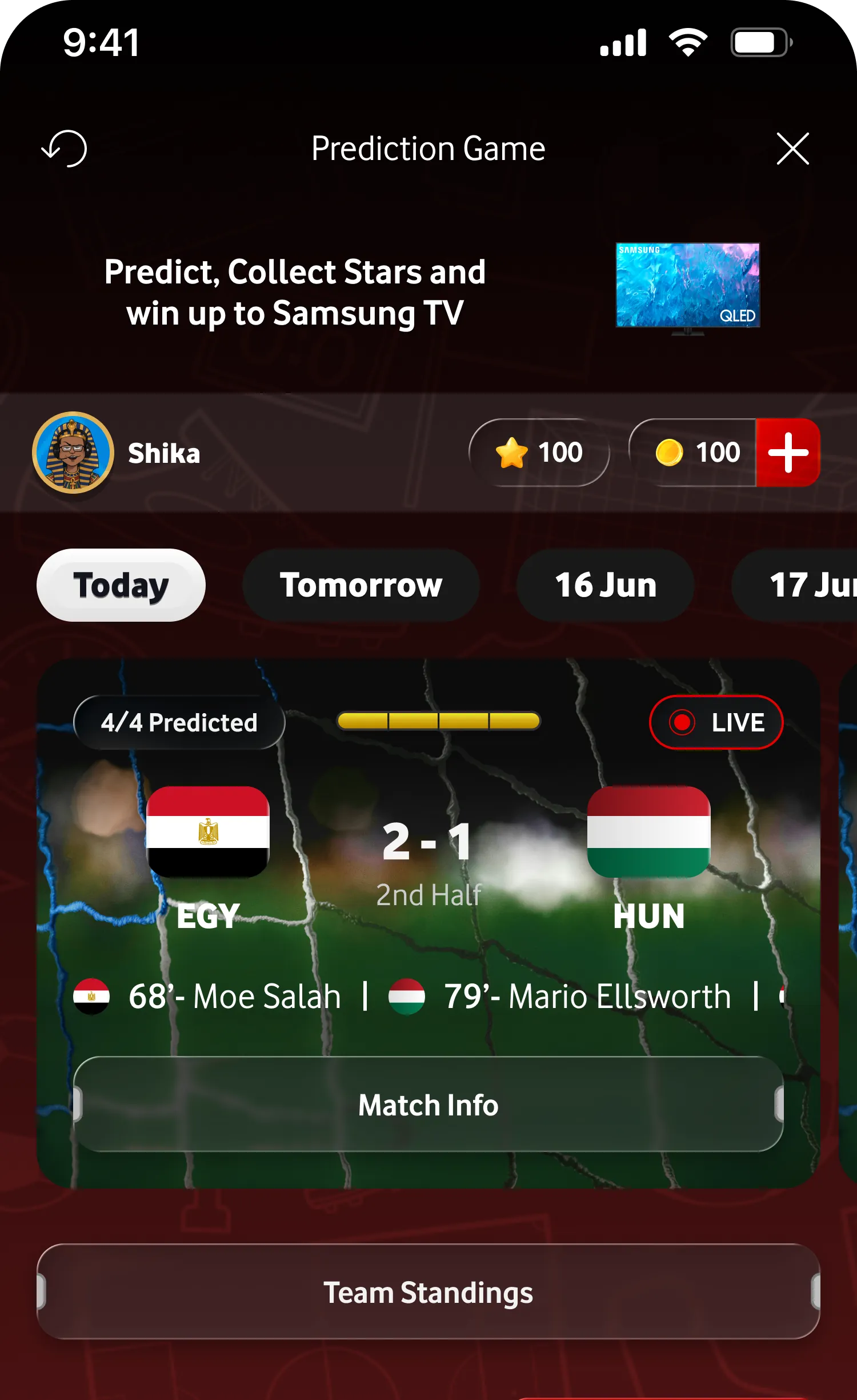
Match day splits players into two journeys that had to share one home screen. The first wants the score, the key match events, and nothing else. The second wants their league rank, their next bonus prediction deadline, and a sense of progress toward a reward.
Building both into a single scrollable screen, instead of separate tabs, meant the casual glance and the deeper session could coexist without competing for attention.
Strategy
The home screen leads with the live match card: score, key match minutes, and one-tap shortcuts into “Match Info” and “Team Standings.” Bonus predictions, like predicting the tournament final for a data bundle reward, sit directly below with their own deadline. Leagues and the leaderboard come next, visible without a tab switch. Each layer rewards a deeper look without forcing one, so a fan who only wants the score still gets a fast, complete screen.
UX Decisions
Two separate reward currencies
Stars for prediction accuracy, coins for pure participation, so the game can reward being right and reward showing up differently.
One scrollable home screen
Not a tab-heavy dashboard - the score, the next deadline, and a league rank are all visible without extra navigation.
Deadlines shown directly on each card
A player never has to remember or look elsewhere to know their prediction window is closing.
League creation reduced to two buttons
Placed directly under the leaderboard, so competing with friends never needs a separate flow.
Wireframes
Structure work happened directly in Figma alongside the visual design, building on the layout grid and component set already established for Vodafone Egypt’s earlier tournament prediction games rather than starting from a blank page. The full design file was reviewed and signed off inside Figma before build.
UI Design
The interface uses a day-selector row (Today, Tomorrow, and upcoming match dates) above a live match card with team flags, score, and key event markers. A trophy-illustrated “Predict the FINAL” banner calls out the tournament’s biggest bonus prediction.
Below it, a “My Leagues” module holds league tabs, a ranked list with avatars, coin and star totals per player, and Create League and Join League actions.
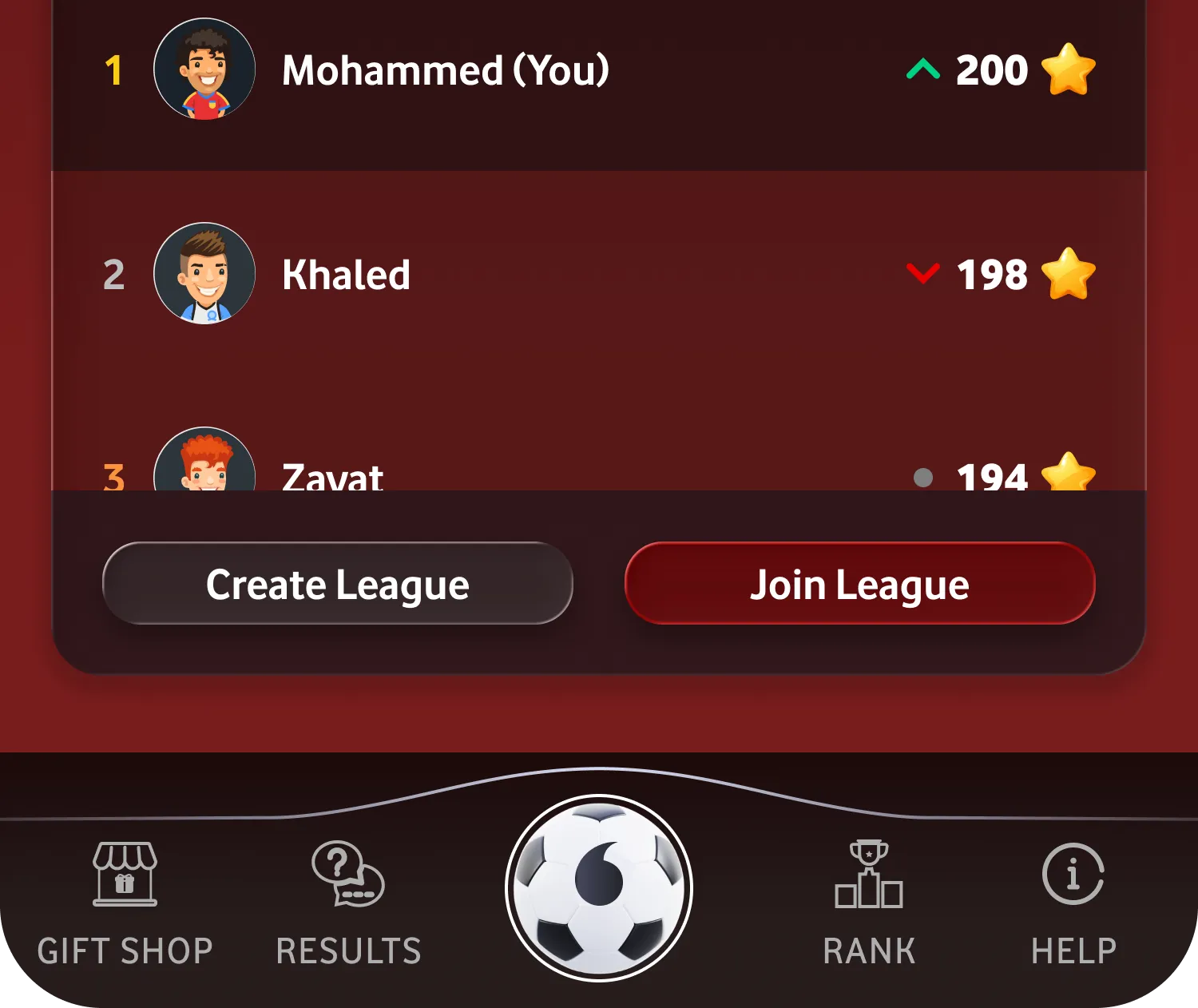
A bottom navigation bar (Gift Shop, Results, a central match icon, Rank, Help) keeps the game’s other systems one tap away without crowding the home screen.
Motion
Motion stayed deliberately light for this one: reward iconography (stars, coins, the tournament trophy) is shared across screens so the game reads as one system from the home screen to the results screen, rather than carrying a heavy animation budget of its own. That budget went instead into the reward moments themselves, like the trophy artwork on the bonus prediction banner.
Design System
Built on Vodafone Egypt’s existing app shell and its dark, red-and-gold gamification skin, the same visual language used across the network’s other tournament and seasonal campaigns. Reusing that shell meant design time went into the game mechanics and reward system instead of rebuilding basic navigation, color, and type from scratch.
Engineering Collaboration
Accessibility
Testing
Validation came from the first 11 days of live group-stage matches, which also produced the results below.
Business Impact
Takhmeen fil 90 beat its AFCON-era benchmark on every core number within the first 11 days of the tournament, converting a large, mostly casual World Cup audience into both engaged predictors and paying subscribers.
Results
Metrics
Learnings
Live sports content sets its own pace. Designing the match card and deadline system to run off real-time data, instead of shipping fixed content windows, is what let the game absorb a traffic spike far larger than a typical promo.
Reflection
This project was less about inventing a new game and more about tuning a known format under real pressure: a hard launch date, an unpredictable spike, and a benchmark set by a bigger tournament. Keeping the home screen to one honest scroll, instead of splitting casual and competitive players into separate flows, turned out to be the decision that mattered most once the traffic actually arrived.
Keeping the home screen to one honest scroll, instead of splitting casual and competitive players into separate flows, turned out to be the decision that mattered most once the traffic actually arrived.