Fawazeer
Vodafone Egypt's seasonal multiplayer TV trivia experience, rebuilt each year with a UI redesign that made multiplayer a clearer growth driver.
- Role
- Senior UX/UI Designer
- Company
- Vodafone Egypt
- Project type
- Gamified campaign
Ownership: End-to-end product design across the seasonal game experience: journeys, multiplayer structure, UI, reward states, and delivery QA.
+65% subscriptions and +75% plays vs. target after the UI redesign
Evidence: Internal launch reporting measured against the campaign target after the redesigned experience shipped.
Contents
Overview
Fawazeer is Vodafone Egypt’s largest game-like experience: a trivia game built around TV shows, with single-player and online multiplayer modes, private and public rooms, levels, leaderboards, streaks, and a gift vault with real prizes ranging from data bundles to Samsung TVs. It is now in its 7th edition since 2023, rebuilt every Ramadan and every summer, with a dedicated edition for the World Cup. The latest cycle reached 34M plays, 75% above target, after a UI redesign aimed squarely at multiplayer.
Problem
Fawazeer’s audience is the whole Vodafone Egypt network, not a self-selecting group of gamers. Every feature had to teach itself in seconds, with no tutorial, while still supporting real depth: multiplayer rooms, levels, streaks, a leaderboard, and a gift vault. Earlier editions ran mostly as a single-player experience.
Multiplayer existed but stayed underused, which meant the game’s most social, most repeatable mode was also its most hidden one.
Goals
- Grow multiplayer participation, not just total plays, since multiplayer sessions are the most repeatable and social part of the game.
- Beat the previous cycle’s ARPU, app usage, and active days without changing the core trivia format.
- Keep the game simple enough for a first-time, non-gamer player while still rewarding repeat, competitive players.
- Give the game a new look every season (Ramadan, summer, World Cup) without rebuilding its structure from zero each time.
Business Context
Fawazeer already had a strong track record, 166M plays across its lifetime and 40M+ hits in the 2026 cycle alone, so the bar for a new edition was not “make people play,” it was “make more of that play multiplayer and paid.” The UI redesign targeted the exact metrics the business cared about: subscriptions, plays, and how much of both came from multiplayer rooms versus single player.
Research
Constraints
Discovery
Looking at where single-player and multiplayer diverged, the game was not failing at rewards or content - it was failing at getting people into a multiplayer room in the first place.
Room discovery and joining sat behind more steps than a casual player was willing to take, so most of the audience defaulted to single player even when multiplayer was the more rewarding, more social mode.
Strategy
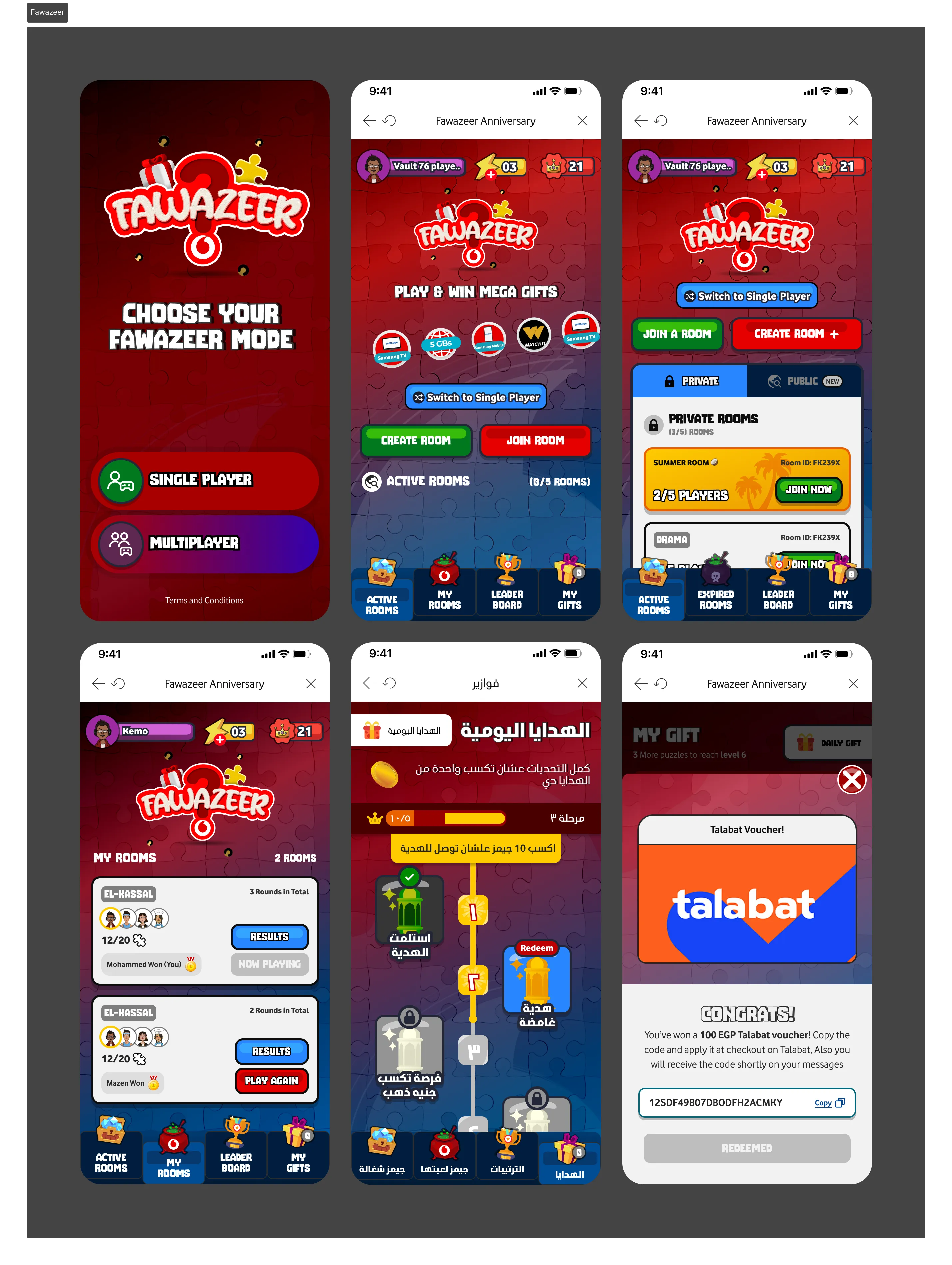
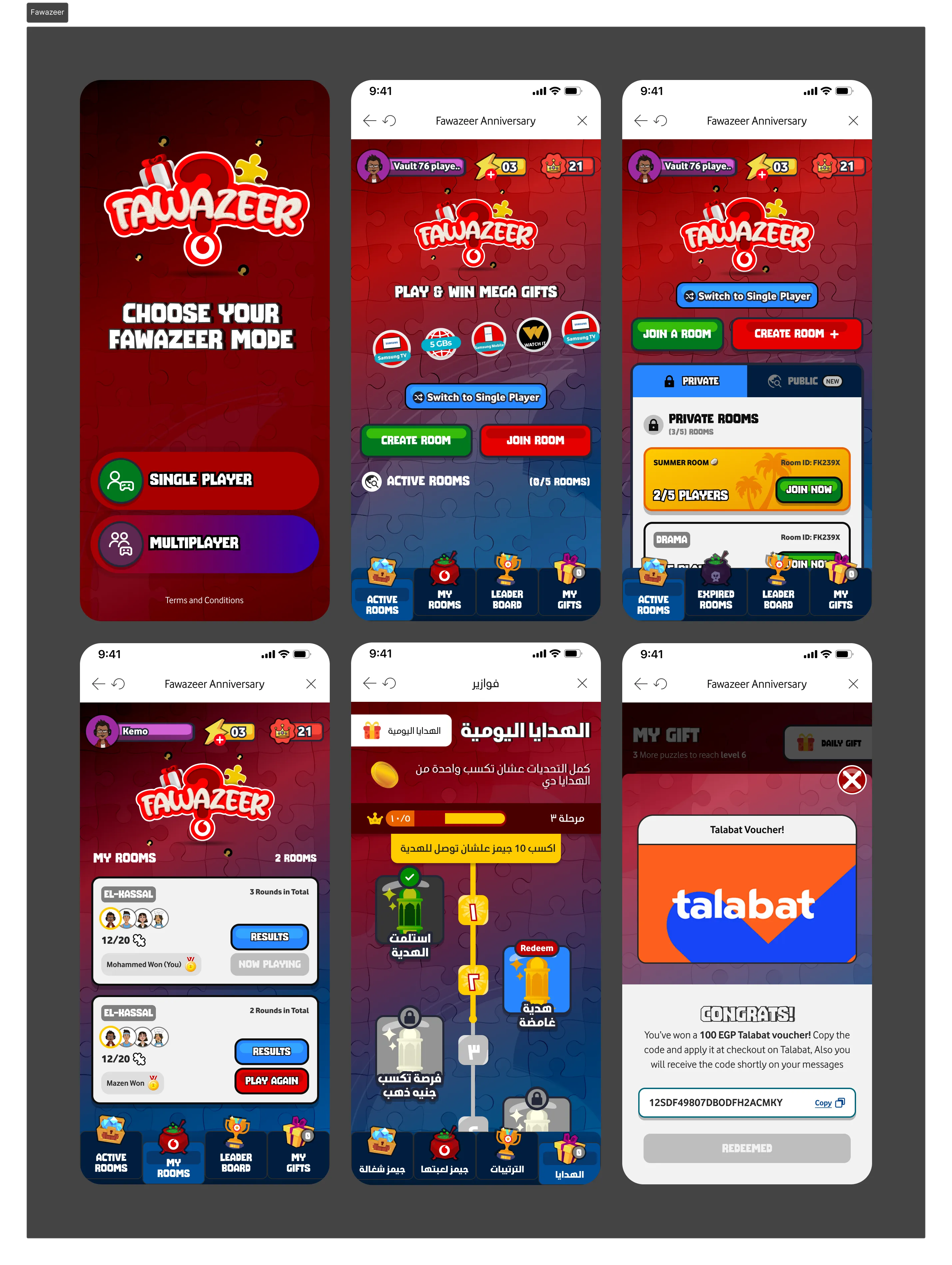
The redesign concentrated on the navigation and room flow: active rooms, private rooms, and the join/create actions all moved closer to the surface, with room capacity and player counts visible before committing to join. Rewards stayed visually present throughout, not locked away until the end, so streaks and the gift vault kept reinforcing why a multiplayer session was worth finishing.
UX Decisions
Active and private rooms surfaced as their own browsable lists
Each shows live player counts (for example, a private room showing 2/5 players), so joining a game in progress needs no more than a glance and a tap.
A single Create Room / Join Room choice
Presented together, instead of separating single-player and multiplayer into different app sections.
Reward progress shown as a visible path
A streak tracker showing days completed toward a hint or better odds, rather than a hidden counter, so progress toward a prize is always legible.
Rooms capped at 5 players
Keeping multiplayer sessions small and fast rather than large and slow to fill.
Wireframes
Navigation and room-flow structure were reworked directly against the existing Fawazeer component library, reusing its card and list patterns rather than introducing new ones, since the goal was to fix the path to multiplayer, not redesign the trivia experience itself.
UI Design
The mode-select screen leads with a single choice: single player or multiplayer, over Fawazeer’s red gift-box branding. From there, active and private rooms list as cards with live player counts and join actions. A “My Rooms” view shows rooms already joined alongside past results, so a player can jump back into an unfinished game. A separate daily-gifts screen shows a Ramadan-style streak path with claimed and unclaimed days, ending in a reveal screen for the actual prize, shown here as a redeemed Talabat voucher with its code ready to copy.
Motion
Reward reveals carry the heaviest motion in the game: the gift vault opens into a voucher card with its own confirmation state, and the streak path animates forward as days are completed. Keeping this motion concentrated on rewards, rather than spread across every screen transition, meant the redesign could ship fast across a large surface area without a full animation rebuild.
Design System
Fawazeer runs on its own red-and-gold gift-box visual identity, distinct from Vodafone Egypt’s general app shell but consistent across all 7 editions so returning players recognize the game instantly each season, even when the trivia content and game mode underneath changes completely.
Engineering Collaboration
Accessibility
Testing
The real test was the redesign shipping into a live seasonal cycle and being measured against the previous one on the same metrics, rather than a pre-launch usability round. The comparison in Results and Metrics below is that direct before-and-after read.
Business Impact
The UI redesign shifted Fawazeer from a mostly single-player game with underused multiplayer into one where multiplayer subscriptions grew nine times over the previous year - the clearest sign that simplifying navigation and the room flow removed the real barrier to multiplayer, not the trivia format itself.
Results
Metrics
Learnings
The biggest gains did not come from adding new game mechanics, they came from removing friction on the path to a mode that already existed and already worked.
Reflection
Fawazeer is proof that a strong seasonal format can carry a lot of change underneath it, new trivia content, a new game mode, a new visual skin, every single cycle, as long as the core navigation stays legible. The redesign’s job was not to reinvent the game every player already liked, it was to stop hiding the version of it that worked best.
The redesign’s job was not to reinvent the game every player already liked, it was to stop hiding the version of it that worked best.