Summer Promo: AI Celebrity Song
A summer campaign that turns a name and phone number into a personalized song, voiced through one of four officially licensed AI celebrity options, that users can send as a real gift rather than a generic promo message.
- Role
- Senior UX/UI Designer
- Company
- Vodafone Egypt
- Project type
- AI-generated campaign gift, mobile web
Turned a summer promo into a personal, shareable gift through officially licensed AI celebrity vocals
Contents
Overview
This summer campaign used officially licensed AI voice generation to turn a promo into a personal gift: a user enters a loved one’s name and phone number, selects from four licensed celebrity voice options, and receives a custom song ready to send directly to that person.
Problem
Most promo mechanics ask a user to claim something for themselves; this one needed to work as a gift a user gives to someone else, which raises the bar for how personal and polished the result has to feel.
A generic template song with a name awkwardly inserted would undercut the entire idea; the output needed to feel like a real, custom-made song, not a mail-merge novelty.
Goals
- Make the personalization (the loved one’s name inside the song) feel seamless, not like a name crudely dropped into a fixed track.
- Offer a choice of four officially licensed celebrity voice options so the result feels selected, not assigned.
- Make sharing the finished song to the named person a one-tap action, since the entire idea depends on it actually reaching them.
Business Context
Summer promos compete for attention in a season full of them, and a mechanic that produces something a user is proud to send to someone else (rather than just claim for themselves) extends the promo’s reach past the person who first opened the app. This was a deliberate bet on AI voice generation as a tool for personal, emotional impact rather than novelty for its own sake.
Research
Constraints
Discovery
The clearest opportunity was treating the celebrity-voice mechanic as a complete gift, not a teaser. Rather than a short clip meant to drive a user back into a full app experience, the song itself needed to be the whole deliverable.
Strategy
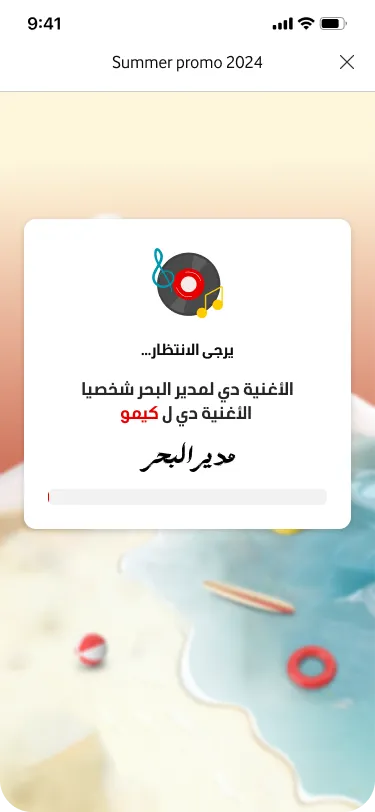
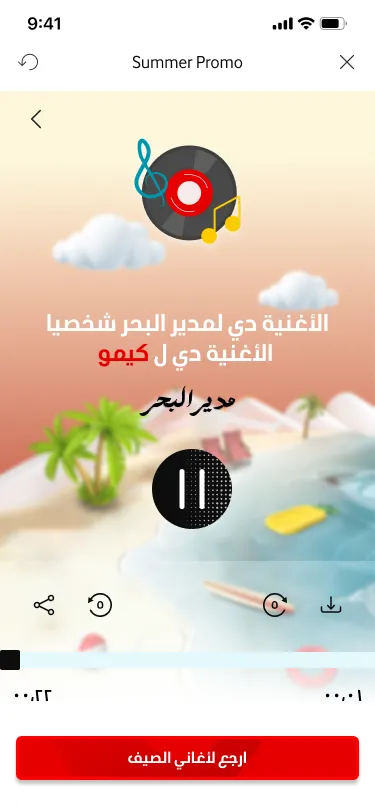
The flow starts with a short setup: a name and phone number for the person receiving the song, then a choice of one of four officially licensed celebrity voice options. It generates and plays the finished track inside a warm, illustrated summer-beach player screen. A prominent “send the song” action makes the moment shareable.
UX Decisions
A finished piece of content, not a plain audio bar
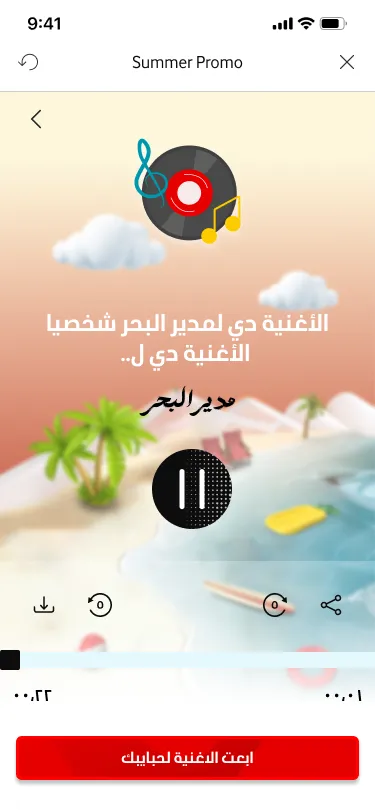
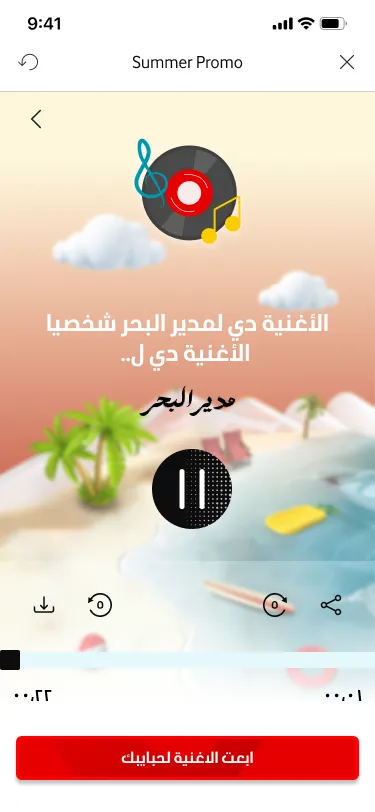
The player screen frames the song visually, a title card referencing the recipient by name, a summer-beach illustration, standard playback controls, so the moment feels like a finished piece of content, not a system-generated file.
The most visible button on the screen
The send action stays the primary, most visible button on the player screen, since the mechanic’s entire value depends on the song actually reaching the person it names.
Four options, not a long list
Voice choice is limited to four options instead of a longer list, keeping the personalization decision quick, not its own lengthy browsing task.
Wireframes
Structure work focused on keeping the path from “type a name” to “hear and send the finished song” as short as possible, since any added step between generation and sharing risked losing the moment’s emotional immediacy.
UI Design
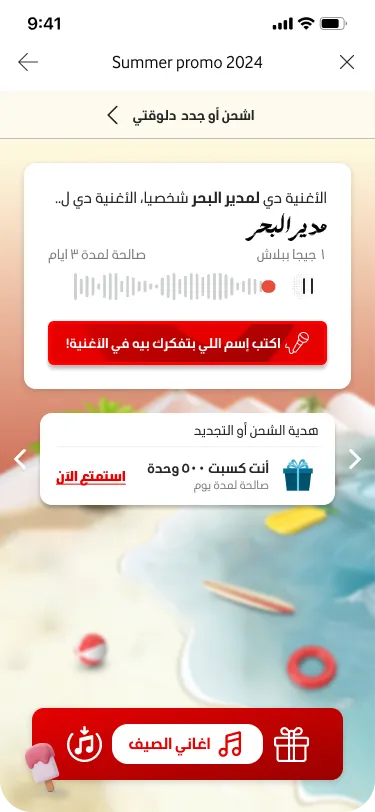
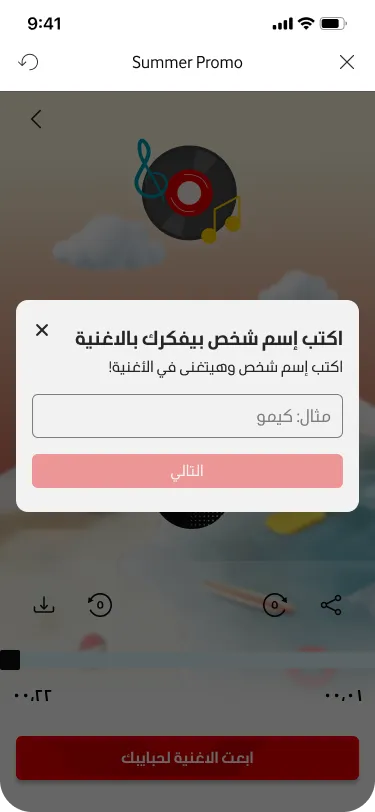
The input step is a focused name prompt inside the player, followed by a short generation state and the finished personalized track. The player uses a warm illustrated beach scene, palm trees, a pool, and a sun-faded gradient sky. A vinyl-record icon and musical notes frame the title, while familiar playback, download, replay, and share controls keep the generated result usable.
Motion
Motion stayed atmospheric rather than showy: subtle cloud and gradient-sky styling on the player screen reinforced the “summer gift” mood without competing with the actual content (the song and the send action), which needed to stay the clear focus.
Design System
The player screen breaks from Vodafone’s typical red-and-white system in favor of a warm, illustrated summer palette (sand, sky gradient, ocean blue) suited to the gift’s emotional tone, while the red share/send button anchors it back to the brand.
Engineering Collaboration
Accessibility
Testing
Functional validation confirmed that a submitted name and number reliably produced a correctly personalized song that could be sent successfully.
Business Impact
By making the AI-generated output something a user sends to someone else rather than keeps for themselves, the campaign extended its own reach past its initial audience: each finished song is also a message to a person who wasn’t in the app a moment before.
Results
The campaign shipped as a complete flow: a two-step personalization form, a four-voice AI song generator, and a finished, shareable song delivered inside a dedicated player experience.
Metrics
Videos
No verified motion export is available for this project. The five production screens above document the complete interaction sequence without substituting unrelated campaign footage.
Learnings
AI voice generation earned its place in this campaign because it solved a problem generic templating couldn’t: making a mass-market promo feel individually made for one specific person.
Reflection
This project is a useful counterpoint to the more craft-driven, hand-built motion work elsewhere in this portfolio: the interesting design problem wasn’t animation technique, it was recognizing which emerging tool (AI voice) could turn a routine promo into something a user would actually want to give to someone else.
The interesting design problem wasn’t animation technique, it was recognizing which emerging tool could turn a routine promo into something a user would actually want to give to someone else.